Tiếng Việt
 中文 (中国)
GoodWe GW30K-ET-10: A 30kW Three-Phase Hybrid Inverter for Commercial Solar
Choosing a solar inverter involves more than matching a power rating to a rooftop installation. Businesses also need to consider when they consume electricity, whether battery storage is useful, and which equipment should remain operational during a grid outage.
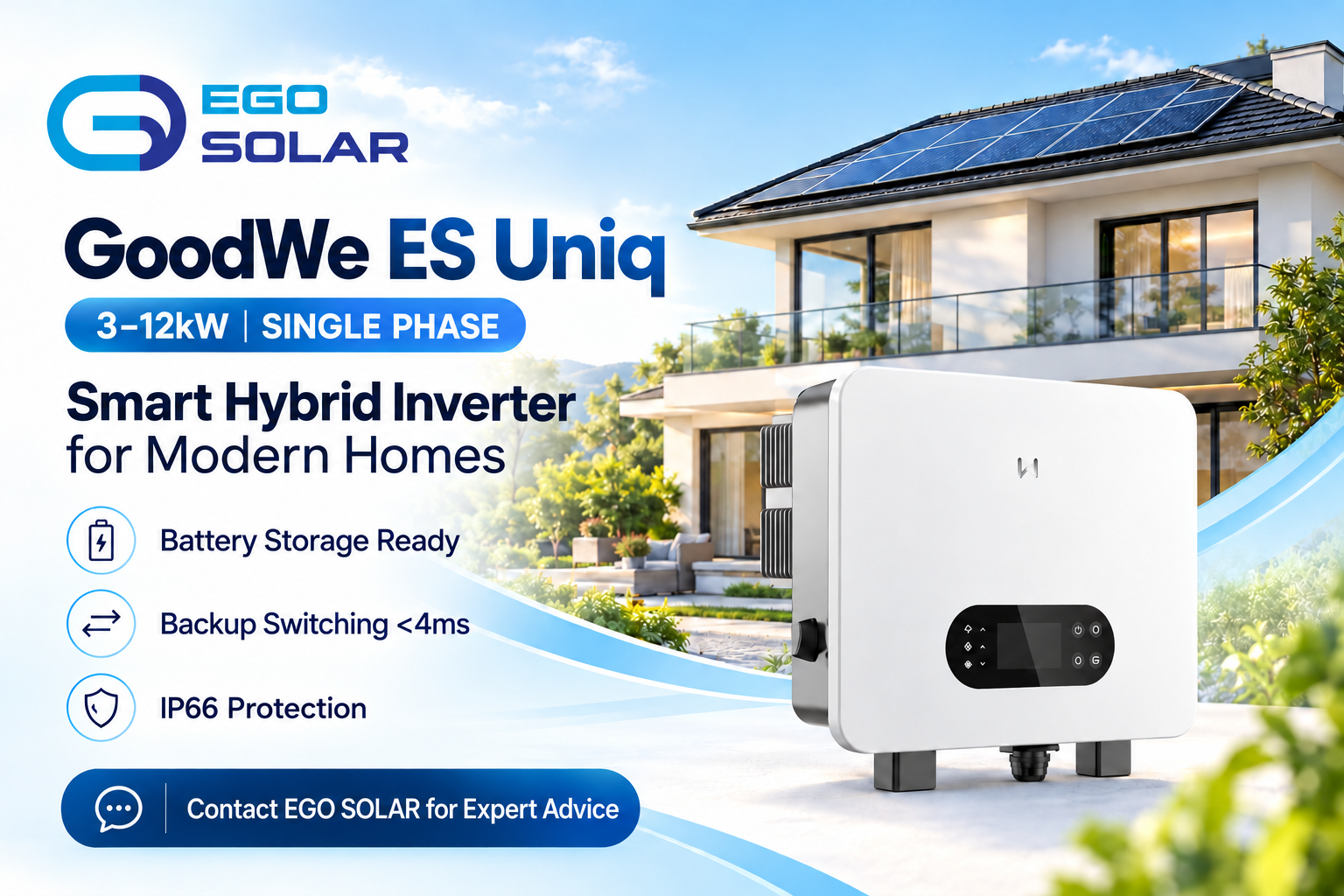
The GoodWe GW30K-ET-10 is a 30kW three-phase hybrid inverter designed for commercial and industrial solar applications. It belongs to the GoodWe ET 25–50kW series and supports compatible high-voltage battery storage.
This guide covers its key specifications and the practical questions to address when planning a solar installation with EGO SOLAR.
GoodWe GW30K-ET-10 Specifications
The following specifications apply to the GW30K-ET-10 model.
| Specification | Value |
|---|---|
| Rated output power | 30kW |
| Nominal output voltage | 380/400V, three-phase |
| Number of MPPT trackers | 3 |
| Maximum input current per MPPT | 42/32/42A |
| Battery voltage range | 200–800V |
| Maximum continuous charging/discharging current | 100/100A |
| Maximum efficiency | 98.1% |
| Ingress protection | IP66 |
| Dimensions, width × height × depth | 520 × 660 × 260mm |
| Weight | 62kg |
Confirm the supplied equipment version and applicable documentation before ordering. Similar product names should not be treated as interchangeable when preparing a system design.
How a Hybrid Solar System Supports Business Energy Use
A hybrid solar installation combines solar generation with the option of battery storage. The value of this arrangement depends on how closely the system matches the building’s electricity demand.
Using Solar Electricity During Business Hours
For businesses operating during daylight hours, solar generation can supply part of the electricity consumed on site.
A workshop with steady daytime activity may have a different energy profile from a restaurant that becomes busiest in the evening. Even if their monthly electricity bills are similar, their preferred solar and storage configurations may differ.
The starting point should therefore be an assessment of consumption throughout the day, rather than monthly spending alone.
Storing Surplus Generation for Later Use
Where solar production exceeds immediate demand, a compatible battery system can provide a way to store energy for later consumption.
For example, a business with reduced activity around midday and higher demand in the late afternoon may consider storage to shift some of its solar energy between those periods.
The battery must still be sized carefully. An oversized battery may be underused, while an undersized battery may not meet the intended operating objective. Expected charging opportunities, usable capacity and discharge requirements all need to be considered.
Planning for Backup Power
GoodWe specifies that the backup output of this inverter range requires an additional compatible STS Box. The ET series also supports parallel configurations under the manufacturer’s system requirements.
A backup installation should begin with a clear list of essential loads. Keeping lighting, network equipment and selected computers running is a different design task from supporting production machinery.
Battery capacity, equipment startup demand and the required operating duration must be evaluated together.
Which Projects Should Consider a 30kW Hybrid Inverter?
The GW30K-ET-10 can be considered for projects where a three-phase hybrid configuration matches the site’s electrical requirements. Its suitability should be assessed through a project-specific design.
Workshops and Manufacturing Facilities
A workshop may have several machines operating simultaneously, with demand changing throughout a production shift.
Before selecting an inverter, the project team should identify:
- Equipment normally operating at the same time.
- Motor startup characteristics.
- Daily and seasonal operating schedules.
- Loads that must continue during an outage.
- Planned increases in production capacity.
Roof conditions also matter. Available space, shading and structural suitability influence how the solar array can be installed.
Offices and Commercial Buildings
Offices often combine daytime air-conditioning demand with lighting, computers and equipment that operates beyond normal working hours.
Separating these loads into operating groups helps clarify whether the main objective is daytime solar use, energy storage or backup support.
This approach also makes it easier to define which circuits should receive priority when designing a backup arrangement.
Businesses Planning Future Expansion
A business expecting to add machinery or extend working hours should include those plans in the initial assessment.
Allowing suitable space for equipment, cable routes and electrical distribution can make later work more straightforward. However, future expansion should still be checked against equipment compatibility and the final electrical design.
Choosing Battery Storage for the GoodWe GW30K-ET-10
Battery selection should address both compatibility and the intended operating purpose.
Understand the Difference Between kW and kWh
Power and stored energy describe different aspects of a system.
Kilowatts, or kW, describe power. Kilowatt-hours, or kWh, describe energy. An inverter’s 30kW rating does not mean that the installation must use a 30kWh battery.
As a simplified illustration, a constant 5kW load operating for four hours requires 20kWh of energy before accounting for conversion losses, reserve settings and other operating limits. This is an example of energy demand, not a recommended battery size.
An actual storage design must also consider the battery’s usable capacity and its ability to supply the required power.
Check the Approved Battery Configuration
A battery should not be selected solely because its voltage falls within the inverter’s operating range.
The installer should verify the exact battery model, battery-management communication, firmware requirements and supported system arrangement against the manufacturer’s compatibility documentation.
This check should take place before equipment is purchased.
Define the Main Storage Objective
Different objectives can lead to different battery configurations. A business may want to:
- Use more of its solar generation on site.
- Supply selected equipment during outages.
- Shift stored energy to another operating period.
- Prepare for a planned change in electricity demand.
Defining the priority helps avoid a configuration that is technically capable but poorly matched to everyday use.
What Affects the Performance of a Commercial Solar Installation?
The inverter is one part of a complete system. Overall results also depend on the solar array, installation conditions and operating strategy.
Solar Array Layout
Roof orientation, shading and available installation space influence energy generation. Array design must also remain within the electrical limits of the selected equipment.
A larger array does not automatically solve every energy requirement. The generation profile needs to be compared with the building’s consumption pattern.
Load Profile
Two businesses with similar annual electricity use can have different opportunities for direct solar consumption.
A site with consistent daytime demand may use a substantial share of its generation immediately. A site with evening demand may require a different balance between array size and storage capacity.
Installation and Maintenance
Equipment positioning, ventilation, cable routing and access for inspection should be addressed during design.
Monitoring and periodic checks can help identify changes in operation that require investigation. Keeping installation records and equipment documentation accessible also supports future maintenance.
GoodWe GW30K-ET-10 Pricing: What Should a Quotation Include?
The price of the inverter alone should be distinguished from the cost of a complete solar and storage installation.
Depending on the project, a quotation may include solar modules, batteries, switching equipment, electrical protection, mounting materials, cabling and installation work.
When comparing proposals, check that each quotation clearly identifies:
- Exact product models and quantities.
- Included accessories and optional equipment.
- Installation and commissioning scope.
- Battery configuration, where applicable.
- Backup loads and operating assumptions.
- Warranty terms and technical support arrangements.
- Taxes, delivery and other relevant charges.
A clearly defined scope provides a more useful basis for comparison than a headline price.
Information to Prepare Before Requesting a System Proposal
To help EGO SOLAR understand your project, prepare recent electricity bills and a description of normal operating hours.
Photographs of the roof, main electrical panel and proposed equipment area are also useful. If backup power is required, list the equipment you want to keep running and the desired operating duration.
Include any plans to add machinery, increase production or extend business hours. These changes may affect the preferred system configuration.
Frequently Asked Questions
Is the GoodWe GW30K-ET-10 a battery?
No. It is a hybrid inverter. A battery is a separate component that must be selected as part of a compatible storage system.
Does a 30kW inverter generate 30kWh of electricity per day?
No. The inverter rating describes power, while daily generation is measured in energy. Actual production depends on the solar array, weather, shading and other operating conditions.
Can battery capacity be selected from the inverter rating alone?
No. Battery selection requires an assessment of energy demand, required power, operating duration and the supported equipment configuration.