Tiếng Việt
 中文 (中国)
GoodWe 100kW Hybrid Inverter for Factories: A Guide to the GW100K-ET-G10
A factory can have plenty of roof space and still have little use for a large battery. The deciding factor is often the production schedule. If the plant consumes almost everything its roof generates, direct solar consumption does most of the work. If demand falls at lunchtime and rises again on the evening shift, storage can move some of that midday electricity to a more useful hour.
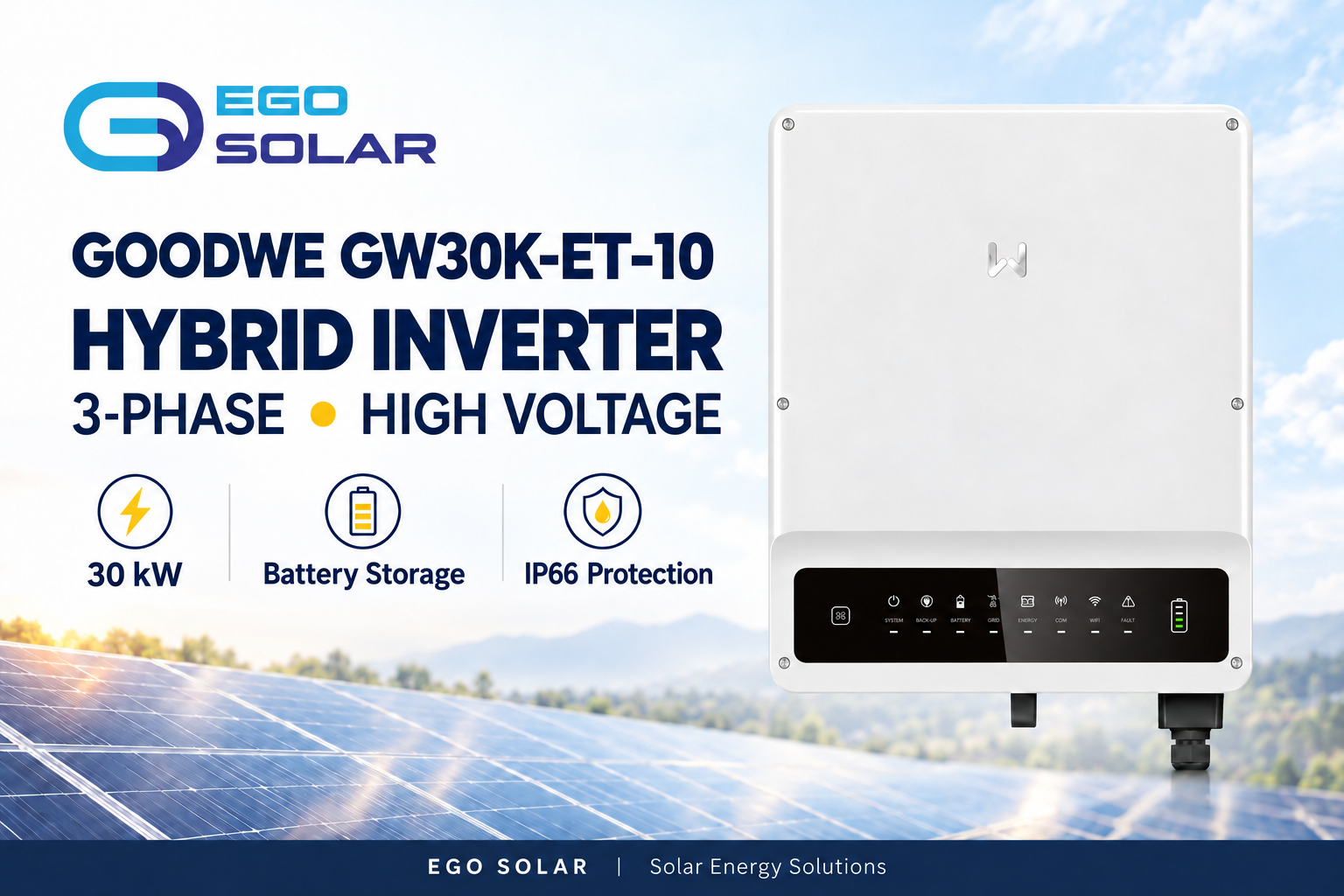
The GoodWe 100kW hybrid inverter (GW100K-ET-G10) is a three-phase unit in GoodWe’s commercial and industrial ET Series. It supports up to 200 kW of PV input, eight independent maximum power point trackers and two high-voltage battery inputs. For a factory evaluating this model, the practical question is how these capabilities fit the roof, the machinery and the hours between shifts.

GoodWe 100kW hybrid inverter specifications for factory projects
GoodWe publishes several ET models in the same datasheet. The figures below come from the GW100K-ET-G10 column. When comparing quotations, ask suppliers to list the full model number for both the inverter and the battery system. A reference to the ET Series alone leaves room for different power ratings and configurations.
| Specification | GW100K-ET-G10 |
|---|---|
| Nominal AC output apparent power | 100 kVA, three-phase |
| Maximum PV input power | 200 kW |
| PV tracking | 8 MPPTs, up to 2 strings per MPPT |
| MPPT operating voltage range | 160–950 V |
| Battery type and voltage range | High-voltage lithium-ion, 300–800 V |
| Battery connections | 2 independent inputs, up to 110 A continuous charge or discharge current per input |
| Maximum inverter efficiency | 98.1% |
The 200 kW figure describes the maximum PV input on the DC side. The 100 kVA figure describes nominal apparent power on the AC side. A proposal may pair a solar array rated above 100 kWp with this inverter, but the larger array does not turn it into a 200 kW AC unit. Ask how much additional generation the factory could use over the year and how much would be limited during periods of strong sunlight.
Start with a week of factory meter readings
A monthly electricity bill gives the purchasing team a total, but it does not show whether the cutting line starts before sunrise or whether the packing hall runs after dark. Ask the operations team for meter readings at 15- or 30-minute intervals, if available. Choose a representative working week and include a weekend or shutdown day. For seasonal production, repeat the exercise during a quieter month.
Mark shift changes, breaks and the start of large machines. Then ask the designer to overlay expected rooftop solar generation on the same timeline. Where generation and demand overlap, the plant can use solar electricity directly. Where generation exceeds demand, the difference is potential charging energy, subject to the battery’s available capacity and charge limits.
Consider a plant that closes its press shop at noon but keeps refrigeration running. A shutdown schedule alone might suggest that the whole site has stopped consuming power. Meter readings may show a substantial cooling load that already absorbs much of the lunchtime generation. That finding can change the preferred battery size before anyone requests a quotation.
Use the eight MPPTs to account for roof orientation
Industrial roofs often span several halls built at different times. One hall may face east, another west, and a ventilation stack may shade part of a third roof. An MPPT adjusts the electrical operating point of its connected solar strings. Eight independent trackers give the designer flexibility to group strings with similar conditions rather than forcing differently oriented arrays to operate together.
For procurement, the useful deliverable is a roof plan showing which module strings connect to each tracker. Request the expected morning and afternoon generation profiles as well. A west-facing section that helps supply a late shift may be valuable even when another section produces more electricity over the full year.
Ask for the expected gain from each proposed expansion. If an extra section produces mainly on Sunday, when production is idle and the battery is already full, its value to the factory may be modest. If that section supplies a packaging line during weekday afternoons, the same number of installed modules could displace more purchased electricity.
Size battery storage for the shift it will serve
Battery quotations need two numbers: power in kilowatts and energy in kilowatt-hours. Power determines how much demand the battery can serve at one moment. Energy determines how long it can sustain that demand. A large energy rating alone tells the buyer little about whether the system can handle several machines starting together.
A worked example for an evening shift
Suppose a packaging line averages 24 kW and its auxiliary equipment adds 6 kW. Supporting both for two hours requires 30 kW × 2 hours = 60 kWh delivered to the loads. This is an illustrative operating target. A supplier still needs to account for conversion losses, the usable battery operating range and any energy the factory intends to reserve for outages.
Now check the charging side. If the roof typically produces only 40 kWh of surplus solar energy on working days, that surplus alone cannot deliver 60 kWh to the evening loads. The plant could cover a shorter period, prioritize one machine or review whether more productive roof space is available. Testing these options is more informative than selecting the largest battery in the catalogue.
Confirm the exact inverter and battery combination
The GW100K-ET-G10 supports two independent battery inputs and a 300–800 V battery operating range. Ask the supplier to specify the battery model, system voltage, usable capacity, continuous discharge power and evidence of supported communication with the inverter. A voltage match by itself does not establish compatibility.
Warranty coverage also matters when comparing third-party battery options. EGO Solar publishes a GoodWe battery warranty notice for Vietnam in Vietnamese. Have the supplier confirm the current terms for the exact combination offered and identify the party responsible for diagnosing a fault across the two devices.
Define which loads need backup power
A factory may want its control system to remain online during a grid interruption while allowing less critical equipment to stop. Start with a named list of loads. For each one, record its running power, starting demand, acceptable interruption and required backup duration. This gives the designer a concrete duty to meet and the buyer a basis for checking the proposal.
GoodWe specifies switching in under 10 milliseconds when the system is used with an STS, or static transfer switch. Check whether the quotation includes that device, which circuits it serves and how the proposed system will be tested. Transfer time and backup duration are separate questions: the first concerns the transition, while the second depends on available battery energy and the loads being supplied.
If the same battery serves the evening shift and provides backup, decide how much energy must remain available at the end of the shift. A plant that needs two hours of emergency cooling may choose to reserve more energy than a facility that only needs time for a controlled shutdown. Include that reserve in the savings calculation so the same stored electricity is not counted twice.
Compare quotations using electricity the plant can actually use
Request three annual estimates from each bidder: solar electricity used directly by the plant, solar electricity delivered to loads through the battery, and generation left unused. Keep the production calendar and electricity tariff assumptions consistent across bids. This comparison reveals whether a higher projected saving comes from a better design or simply from assuming longer shifts.
Separate equipment from site work. A complete scope should identify the inverter, modules, batteries, switchgear, monitoring access, installation and commissioning. If one offer includes backup and another covers daytime solar operation only, the difference in total price says little about the value of either proposal. Compare the cost of providing the same service to the same set of loads.
Finally, ask what the facilities team will receive at handover. Useful items include the as-built layout, equipment list, access to monitoring data and a record of commissioning tests. These records give the plant a baseline for investigating changes in solar production or battery performance after the installation team has left the site.
Frequently asked questions about the GW100K-ET-G10
Does this inverter require a 200 kW solar array?
No. The datasheet lists 200 kW as the maximum PV input power. The proposed array size should reflect roof conditions, string design and the plant’s demand profile. Ask the designer to model at least two array sizes if the benefit of adding more modules is unclear.
Can a factory with an existing solar installation add this inverter?
An existing site can be assessed for a retrofit. Share its single-line diagram, inverter models, string configuration and monitoring records. The designer can then identify which equipment could be reused, how the new controls would interact with the existing installation and whether the work requires a production shutdown.
What should we send EGO Solar to request a quotation?
Send the project location, a typical week of meter data, the shift schedule, roof photographs and a list of priority loads. State whether the main objective is daytime self-consumption, evening energy use or backup for a critical process. If several goals apply, rank them so the proposed battery capacity reflects the most important duty.
To discuss a GoodWe 100kW hybrid inverter project in Vietnam, email EGO Solar’s project team at projecteam@egosolar.vn. You can also review EGO Solar’s equipment catalogue when preparing the scope of your request.
Technical reference: GoodWe ET Series 75–100 kW datasheet, English version 2.1, GW100K-ET-G10 model column.